Supply Chain Outsourcing: How to Manage Processes and Governance
Entrusting part of the Supply Chain processes to an external partner does not simply mean moving activities outside the company. It means building an operating model in which scope, data, responsibilities, KPIs, and decision-making methods are defined before the service starts. The transition is the most delicate moment: if managed loosely, Outsourcing risks inheriting unmapped processes, incomplete information, contradictory priorities, and unclear responsibilities.
The most frequent question is not just whether it is worth outsourcing, but how to do it without losing control. Control, in this context, does not coincide with the direct management of every activity. It coincides with the ability to know what is being managed by the partner, which decisions remain internal, what data feeds the service, how performance is measured, and when operational escalations are triggered.
An effective transition to an external Supply Chain service therefore requires a clear roadmap. First, the starting point is assessed, then the scope is delimited, data and processes are prepared, the handover is managed, the service is started in a controlled manner, and, finally, governance is stabilized. It is this path that transforms Outsourcing from a delegation perceived as risky into a manageable model.
Switching to Supply Chain Outsourcing Does Not Mean Losing Control
When a company evaluates entrusting certain Supply Chain activities to an external partner, one of the first questions that emerges is almost always the same: “How much control will we lose?”. It is a understandable concern: processes such as planning, procurement, supplier management, logistics, or operational priority control directly impact production continuity, customer service, and costs. Entrusting these activities externally without a governance model can therefore seem, at first glance, like giving up a part of internal control. In reality, Outsourcing and control are not necessarily alternatives.
The point, however, is not to choose between internal control and external entrustment. The real issue is designing a system in which the partner manages defined activities, while the company maintains visibility, direction, and decision-making capacity on critical points. An external service works when it does not replace internal governance, but makes it more explicit: clear roles, shared information, escalation rules, and readable indicators allow for the process to be overseen even when daily operations are entrusted to a partner.
Why the Issue Is Not Just Delegating Operational Activities
Many transitions to Outsourcing are set up starting from the list of activities to be transferred. It is a necessary step, but not sufficient. If one limits themselves to saying what the partner must do, without clarifying how the process connects to internal functions, who decides in case of an exception, and what data must be updated, the risk is moving the same existing inefficiencies outside the company.
Delegating operational activities therefore requires preliminary work on the process. A report to be updated, a supplier confirmation to be chased, a plan to be verified, or a logistical priority to be managed are not isolated actions. They are parts of a flow involving systems, people, data, and decisions. If the flow is not understood, Outsourcing may only apparently reduce the internal load, subsequently generating requests for clarification, rework, and continuous informal handovers.
What Must Remain Governed by the Company
Even when a significant part of operations is outsourced, certain responsibilities should remain clearly overseen internally.
These include, for example:
- strategic and business priorities;
- decisions regarding critical materials, suppliers, or customers;
- management of high-impact exceptions;
- approval rules;
- performance objectives;
- service level evaluation;
- decisions involving significant economic or operational impacts.
The partner must, instead, have a sufficiently clear scope to be able to act autonomously on the activities within their competence.
This balance is fundamental.
If the scope is too narrow, the partner will be forced to ask for continuous authorizations, effectively reducing the benefit of Outsourcing.
If, conversely, the scope is too broad and intervention thresholds are not defined, the company risks losing visibility on the most relevant decisions.
Defining the Service Scope Before the Handover
The scope is the foundation of the transition. Before starting the handover, the company must clarify which processes pass to the partner, which remain internal, and which require shared management. Without this distinction, every exception can become a discussion about who should intervene and every unforeseen activity can turn into operational friction.
Defining the scope does not mean making the service rigid. It means creating a common base. In an initial phase, it can be useful to start from a limited scope: a category of processes, a family of materials, a logistical flow, a part of planning, or an operational control activity. A start that is too broad, especially if data is not mature or processes are not documented, increases the risk of discontinuity.
Which Processes to Entrust to the External Partner and Which to Keep Internally
The choice of processes to entrust to the partner should be based on operational criteria, not just on the saturation of the internal team. Good candidates are recurring, measurable, documentable processes linked to fairly stable rules. These can include monitoring activities, data updates, progress control, information flow management, recurring follow-ups, operational reporting, or planning support, when the decision-making level is correctly defined.
On the other hand, highly unstable processes, lacking internal ownership, based on inconsistent data, or characterized by continuous exceptions should be evaluated with greater caution. In these cases, before entrusting the service externally, it may be necessary to map the process, clean the information, define rules, and clarify roles. Outsourcing should not become a way to avoid an unresolved organizational problem.
How to Distinguish Operational Activities, Shared Decisions, and Escalations
A well-constructed transition distinguishes three levels. The first concerns operational activities that the partner can manage autonomously, according to defined rules. The second concerns shared decisions, where the partner prepares information, analysis, or proposals and the company maintains decision-making power. The third concerns escalations, i.e., cases where an anomaly, an urgency, or a potential impact requires the involvement of specific roles.
This distinction allows for the avoidance of two extremes: on one hand, the partner blocked on every micro-decision; on the other, the partner forced to decide without a clear mandate. The service becomes more fluid when the rules are known before the start and are updated in a structured way during the stabilization phase.
A useful tool is the RACI matrix, which allows for clarifying for each activity who is:
- R – Responsible. Who performs the activity;
- A – Accountable. Who has final responsibility and makes the decision;
- C – Consulted. Who must be involved;
- I – Informed. Who must be informed.
In this way, for example, the partner can be responsible for monitoring orders and chasing suppliers, while the company maintains decision-making responsibility for critical issues that can have a significant impact on production.
This distinction protects both parties: the company avoids losing visibility on sensitive processes, while the partner works with a clear scope and can operate with greater autonomy.
Preparing Data and Processes Before the Transition
Data is one of the most critical factors in the transition to an external Supply Chain service. A partner can effectively manage a process only if they have consistent, updated, and interpretable information. If, instead, they receive incomplete master data, unverified lead times, unstated priorities, or reports built manually without shared logic, the service already starts with a high level of risk.
Preparing data does not mean making it perfect. It means knowing which information is reliable, which requires correction, and which limits must be overseen during the start-up. Transparency about weak areas is more useful than an apparently orderly snapshot that does not adhere to operational reality.
What Information Is Needed to Start an External Supply Chain Service
The necessary information depends on the scope, but certain categories often recur. Master data on materials, suppliers, customers, or plants involved is needed, along with operational data on orders, stock, lead times, backlog, deliveries and plans, priority rules, meeting calendars and cut-offs, internal references, exception management methods, KPIs, and reports already in use. To this information are added procedures, operational instructions, and decision-making criteria that often exist in practice but are not formalized.
The preparation phase is also an opportunity to distinguish what the partner needs to know from what they must be able to modify. Not all data requires the same level of access. Defining permissions, update responsibilities, and validation methods helps protect information quality and avoid overlaps between the internal team and the outsourcer.
Why Incomplete Data and Unmapped Processes Increase Risk
Incomplete data and unmapped processes make the transition more fragile because they increase dependence on people and informal knowledge. If an activity works only because a planner, a buyer, or a logistics manager knows unrecorded exceptions, shortcuts, and priorities, the external partner will need continuous confirmations. The service becomes slower and the internal team risks not truly freeing up operational capacity.
Mapping must not be bureaucratic. It must reconstruct the essential steps: inputs, outputs, systems used, activity frequency, roles involved, control points, recurring exceptions, and required decisions. In this way, the handover is not limited to the transfer of files or procedures, but becomes an orderly transfer of operational knowledge.
How to Manage the Handover to the External Partner
The handover is the phase where the designed model is put to the test. It should not be concentrated in a few final meetings but built progressively. The partner must understand the real process, shadow the people who manage it, observe exceptions, verify data, and validate rules before fully taking over the service.
An orderly transition reduces the risk of interruptions because it does not abruptly separate the before and after. The goal is to accompany the transition until activities can be managed with sufficient autonomy, responsibilities are understood, and the first KPIs confirm that the service is under control.
Assessment, Mapping, and Operational Shadowing
The path can start from an initial Assessment, useful for capturing processes, data, critical issues, and maturity levels. From here, we move to operational mapping, which clarifies how the process works today and which points must be stabilized before the transfer. Shadowing then allows the partner to see the process in action and to intercept details that rarely emerge from a written procedure.
During this phase, it is important to collect questions, anomalies, and recurring cases. The partner’s questions often reveal gray areas that the organization has managed by habit, without formalizing them. Making these areas explicit before the start allows for the reduction of errors and misunderstandings.
Pilot Phase and Controlled Service Start-up
When the scope allows, a pilot phase helps verify the model on a limited scope. The pilot can concern a process, a function, a family of materials, or a part of the information flow. Its utility lies not only in testing execution but in measuring the quality of the transition: data completeness, clarity of responsibilities, response times, exception management, and the level of collaboration between the internal team and the partner.
The controlled start-up should include a period of close monitoring. In this phase, more frequent meetings, simplified reports, and clear escalation channels help to quickly correct any deviations. Only after stabilization is it appropriate to move to ordinary governance.
KPIs, SLAs, and Responsibilities for Governing Supply Chain Outsourcing
KPIs and SLAs are essential tools for maintaining control and visibility over the service. They should not be understood as a formal post-hoc control mechanism, but as a shared language between the company and the partner. Well-chosen indicators help to understand if the service is ensuring continuity, information quality, punctuality, and the ability to respond to exceptions.
The choice of indicators must reflect the entrusted scope. If the partner manages monitoring activities, accuracy, timeliness, and completeness of updates will be relevant. If they support planning or procurement processes, backlog, meeting deadlines, quality of alerts, priority management, and escalation times may carry weight. If they oversee logistical flows, punctuality, anomalies, pick-up times, and reporting quality can be monitored.
Example of Responsibility Allocation in the Transition
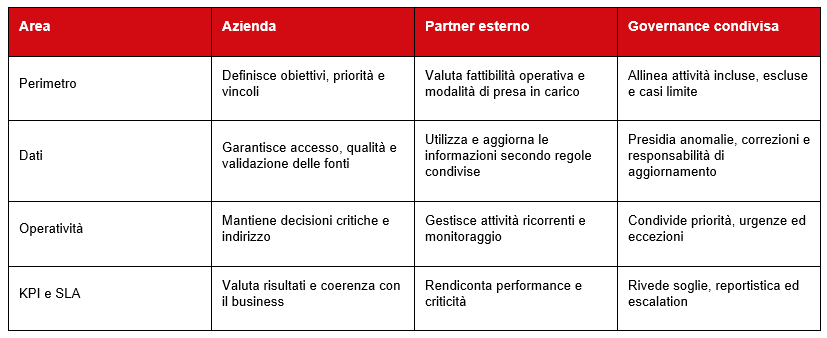
Useful Indicators for Measuring Continuity, Quality, and Service Level
A good set of KPIs should not be too broad. Better to have a few indicators truly linked to the service than an extensive list of metrics that are difficult to interpret. Continuity can be measured through compliance with planned activities and the ability to manage peaks. Quality can be observed through errors, rework, data completeness, and consistency of updates. The service level can be evaluated with response times, SLA compliance, reporting punctuality, and escalation management.
It is useful to define an initial baseline, even when not all data is perfect. Knowing how the process worked before the transition allows for evaluating whether the external service is improving, stabilizing, or simply absorbing existing operations. Without a comparison, judgment remains subjective.
How to Set Up Reporting, Meetings, and Escalations
Reporting must be consistent with the decisions to be made. A daily operational report can serve to manage anomalies and immediate priorities; a weekly meeting can help read trends, backlogs, and recurring critical issues; a monthly comparison can serve to evaluate KPIs, SLAs, improvement opportunities, and scope variations. Frequency should not be defined by habit, but based on the criticality of the service.
Escalations must be simple to trigger and clear to interpret. Each level should indicate the type of problem, the maximum time for taking charge, the functions involved, and the expected decision. In this way, urgencies and exceptions do not depend on personal relationships or informal channels, but on a shared model.
Stabilizing the Model After the Start-up
The transition does not end with the go-live. After the start-up, the model must be observed, corrected, and stabilized. It is normal for adjustments to emerge regarding scope, data, operational rules, meeting frequency, or responsibilities. This does not indicate a project failure, but the need to adapt the service to operational reality.
The stabilization phase is decisive because it consolidates trust between the company and the partner. If critical issues are addressed transparently, the service becomes progressively more fluid. If, instead, they are managed as isolated exceptions or generically attributed to the partner, the risk is creating tension and returning to informal control methods.
How to Avoid Friction Between the Internal Team and the External Partner
Friction often arises when the internal team perceives the partner as a loss of control or when the partner receives inconsistent instructions from different functions. To avoid this, it is useful to communicate clearly why the service is being introduced, which activities are changing, which responsibilities remain internal, and what operational benefits are expected.
Collaboration improves when people see that the partner does not replace internal oversight but absorbs defined activities, brings method, and makes priorities and critical issues more visible. Training also plays an important role: it serves not only to explain procedures but to build a common language on processes, data, KPIs, and escalations.
When to Review Scope, Operational Rules, and KPIs
Scope, rules, and KPIs should not be considered immutable. After the first few months of service, some activities may require more detail, others may be simplified, and some thresholds may turn out to be too sensitive or not selective enough. Periodic review allows for keeping the model aligned with business needs.
Reviewing the service does not mean renegotiating it continuously, but governing it. A mature model includes moments dedicated to improvement, where the company and partner analyze results, recurring critical issues, and possible evolutions. This prevents Outsourcing from remaining stuck at the initial snapshot, transforming it into a progressive operational oversight.
Building a Governed Transition to an External Service
An external Supply Chain service works when the transition is designed before the start-up. The point is not to exit operations without oversight, but to build a model in which activities, data, roles, KPIs, and responsibilities are clear. In this way, the company can reduce internal overload while maintaining visibility over processes and decision-making capacity on critical priorities.
Makeitalia supports companies in Supply Chain Outsourcing journeys, with an operational approach that integrates initial Assessment, process mapping, data preparation, scope definition, handover, KPIs, SLAs, and continuous service governance. When an organization evaluates switching to an external partner or needs to make an already started management more structured, a preliminary discussion can help identify risks, priorities, and necessary conditions for a safer and more manageable transition. Contact us here if you need to tell us about the challenge you are facing.
The Role of a Partner in Managing Processes, Data, and Responsibilities
The partner should not only come in downstream, when the service has already been defined in detail. They can contribute usefully even in the design phase, helping the company clarify which activities to transfer, what data to prepare, which responsibilities to maintain, and which indicators to use. This approach reduces the risk of improvised starts and makes the transition from internal management to an external model more natural.
The quality of Outsourcing depends on the quality of the transition. Where processes, data, and responsibilities are built with method, the service can become a tool to provide continuity, lighten the operational load, and make Supply Chain management more readable.
FAQ
How is the transition to an external Supply Chain service managed?
The transition is managed with a progressive roadmap: initial Assessment, scope definition, process mapping, data preparation, handover, possible pilot phase, controlled start-up, and continuous governance. The transition must clarify which activities pass to the partner, which decisions remain internal, which KPIs measure the service, and how urgencies and escalations are managed.
What data is needed to start Supply Chain Outsourcing?
The data depends on the service scope but generally includes master data, orders, suppliers, materials, stock, lead times, backlogs, plans, operational priorities, exception management rules, KPIs, and reports already in use. It is important to verify the quality of information before the start, because incomplete or outdated data can generate errors, rework, and loss of trust in the service.
How to avoid losing control by entrusting Supply Chain processes to a partner?
Control is maintained by defining scope, responsibilities, indicators, SLAs, reporting frequency, and escalation rules. The company does not necessarily have to manage every activity directly but must be able to read performance, decide on critical priorities, and intervene when the service requires an internal choice. Governance is what makes Outsourcing manageable.
What is the difference between Supply Chain Outsourcing and Temporary Management?
Supply Chain Outsourcing involves entrusting continuous activities or processes to an external partner, according to a defined scope and service model. Temporary Management, on the other hand, temporarily introduces a managerial figure to lead a phase of change, cover a vacant role, or manage a specific project. They are different tools and can respond to different organizational needs.
Which KPIs and SLAs should be used to govern an outsourced Supply Chain service?
Indicators must be consistent with the entrusted process. They can concern activity punctuality, response times, data accuracy, completeness of updates, errors and rework, meeting deadlines, reporting quality, escalation management, and service continuity. SLAs should define expected levels, take-charge times, and exception management methods.
Share on